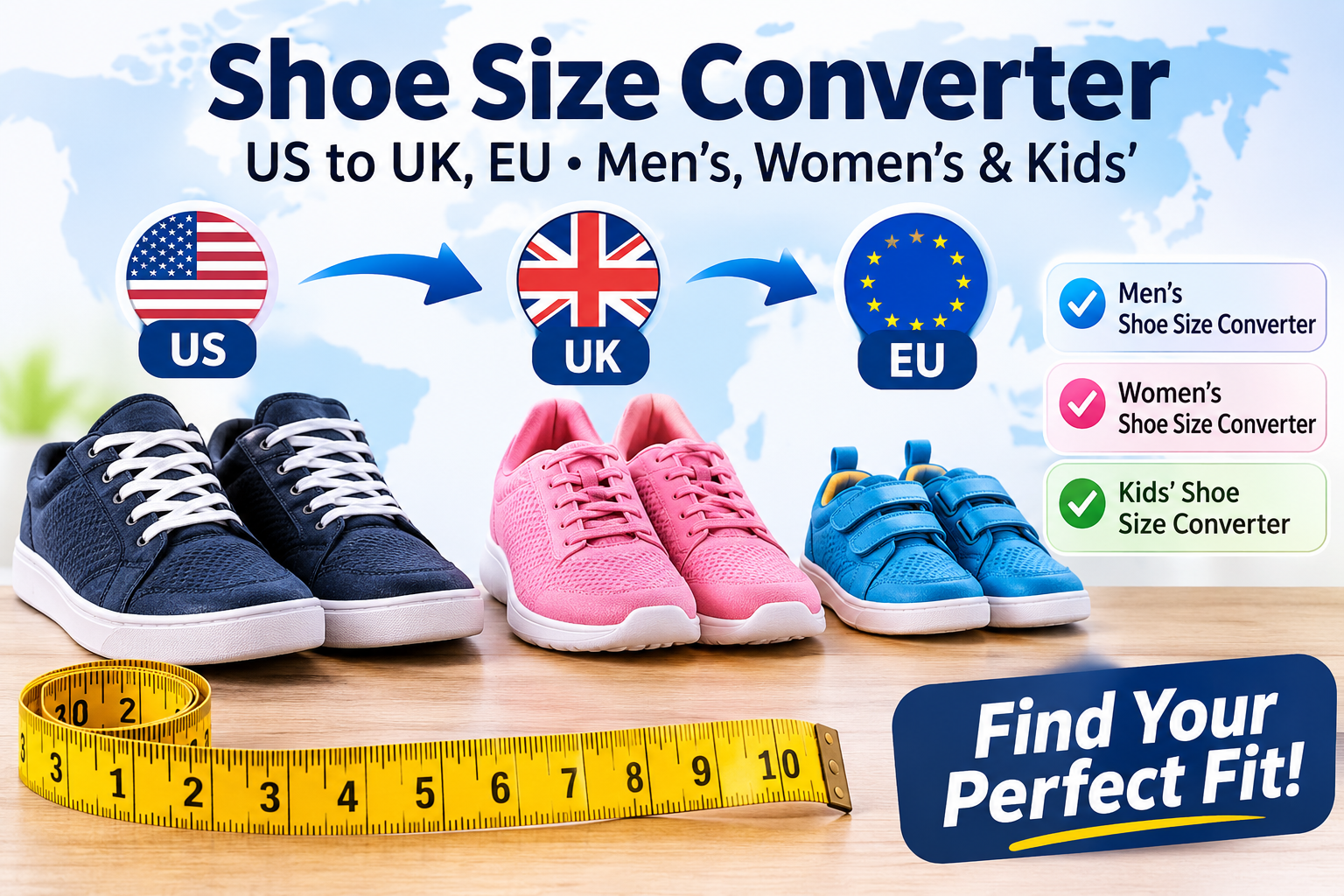
Shoe Size Converter: US to UK, EU, Men’s, Women’s & Kids’ Shoe Size Chart
Finding the correct shoe size is not always easy, especially when shopping from international footwear brands. A US shoe size may not match the same number in the UK or European sizing systems. Men’s, women’s, and children’s shoes also follow different sizing conventions.
A shoe size converter helps you compare footwear sizes across different countries and find the closest equivalent size. Whether you want to convert US to UK shoe size, check US to EU shoe size, or find the right size for men, women, or kids, using a conversion chart can make the process much easier.
This guide includes international shoe size conversion charts, men’s and women’s shoe size comparisons, kids’ shoe size measurements, and practical tips for finding the right fit.
Shoe Size Converter
Convert men’s, women’s, and kids’ shoe sizes between US, UK, and European sizing systems.
Note: Results are approximate conversions. Shoe sizing varies between manufacturers. Check the brand’s official size chart before purchasing.
Quick Shoe Size Conversion
Shoe sizes are not identical across countries. The US and UK use different numbering systems, while European footwear generally follows a separate numerical scale.
Here are a few common examples:
| Shoe Category | US Size | UK Size | EU Size |
|---|---|---|---|
| Men’s | 8 | 7 | 41 |
| Men’s | 9 | 8 | 42 |
| Men’s | 10 | 9 | 43 |
| Women’s | 7 | 5 | 37 |
| Women’s | 8 | 6 | 38 |
| Women’s | 9 | 7 | 40 |
| Kids’ | 5 | 4.5 | 21 |
| Kids’ | 8 | 7 | 25 |
These are approximate conversions. Actual sizing can vary depending on the footwear manufacturer, design, and sizing standard.
How to Use a Shoe Size Converter
A shoe size converter allows you to compare your existing shoe size with equivalent sizes in other countries.
To find your approximate international shoe size:
- Select the appropriate category: men’s, women’s, or kids’.
- Choose the sizing system printed on your current footwear, such as US, UK, or EU.
- Enter or select your shoe size.
- View the equivalent sizes in the other measurement systems.
- Compare the result with the footwear manufacturer’s size chart before purchasing.
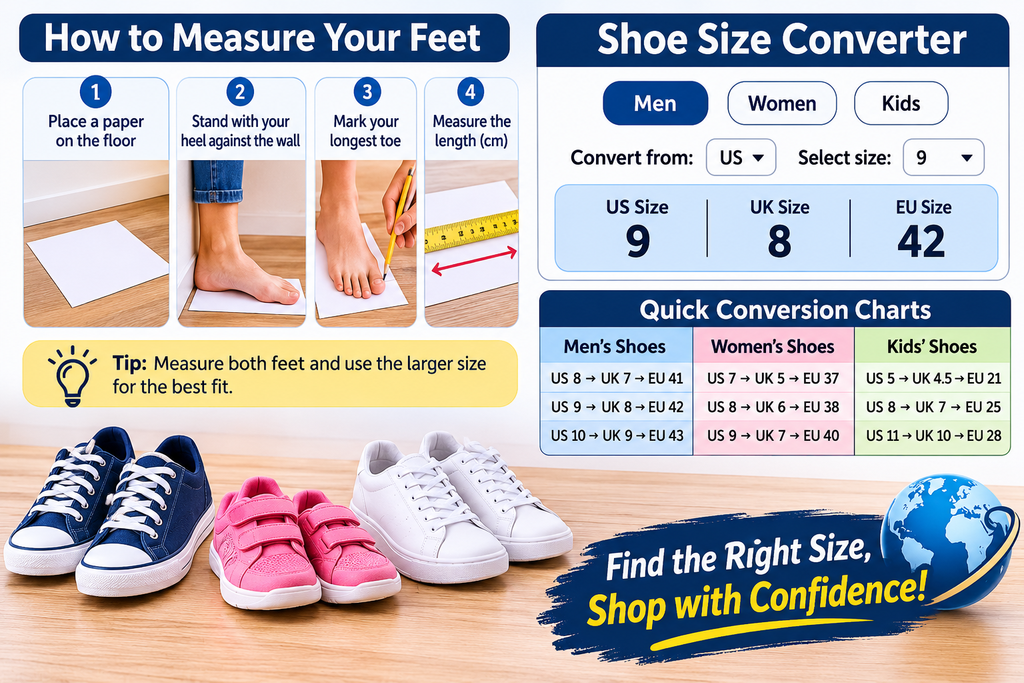
For example, if you wear a US men’s size 9, the approximate equivalents are UK 8 and EU 42.
Remember that shoe size conversion charts provide general guidance. They do not account for every difference in shoe width, shape, or brand-specific sizing.
US to UK Shoe Size Conversion Chart
US and UK shoe sizes use different numbering systems. The conversion also depends on whether the footwear is designed for men or women.
For men’s shoes, a US size is generally around one size larger than its UK equivalent. For women’s shoes, the difference is usually around two sizes.
US Men’s to UK Shoe Size Chart
| US Men’s Size | UK Size | EU Size |
|---|---|---|
| 6 | 5.5 | 39 |
| 7 | 6 | 40 |
| 8 | 7 | 41 |
| 9 | 8 | 42 |
| 10 | 9 | 43 |
| 11 | 10 | 44 |
| 12 | 11 | 45 |
| 13 | 12 | 46 |
| 14 | 13 | 47 |
US Women’s to UK Shoe Size Chart
| US Women’s Size | UK Size | EU Size |
|---|---|---|
| 5 | 3 | 35 |
| 6 | 4 | 36 |
| 7 | 5 | 37 |
| 8 | 6 | 38–39 |
| 9 | 7 | 40 |
| 10 | 8 | 41 |
| 11 | 9 | 42 |
| 12 | 10 | 43 |
If you are shopping from a UK-based footwear store, use the appropriate men’s or women’s conversion chart instead of assuming that both categories follow the same sizing difference.
US to EU Shoe Size Conversion Chart
European shoe sizes are widely used in countries such as Germany, France, Italy, and Spain. Many international footwear brands also display EU sizing alongside US and UK sizes.
Unlike US sizing, European shoe sizes generally use the same numerical scale for men’s and women’s footwear. However, the fit, width, and shape can still differ.
US Men’s to EU Shoe Size Chart
| US Men’s Size | EU Size | UK Size |
|---|---|---|
| 6 | 39 | 5.5 |
| 7 | 40 | 6 |
| 8 | 41 | 7 |
| 9 | 42 | 8 |
| 10 | 43 | 9 |
| 11 | 44 | 10 |
| 12 | 45 | 11 |
| 13 | 46 | 12 |
| 14 | 47 | 13 |
US Women’s to EU Shoe Size Chart
| US Women’s Size | EU Size | UK Size |
|---|---|---|
| 5 | 35 | 3 |
| 6 | 36 | 4 |
| 7 | 37 | 5 |
| 8 | 38–39 | 6 |
| 9 | 40 | 7 |
| 10 | 41 | 8 |
| 11 | 42 | 9 |
| 12 | 43 | 10 |
European sizing can vary between brands, so checking the manufacturer’s foot-length chart is recommended when an exact fit matters.
Men’s Shoe Size Converter and Size Chart
Men’s shoe sizes can differ between American, British, and European footwear systems. A men’s shoe size converter makes it easier to compare these measurements when purchasing shoes from international retailers.
For example, a US men’s size 9 generally corresponds to UK size 8 and EU size 42.
The following chart provides approximate men’s shoe size conversions.
| US Men’s Size | UK Size | EU Size | Approx. Foot Length |
|---|---|---|---|
| 6 | 5.5 | 39 | 24 cm |
| 7 | 6 | 40 | 25 cm |
| 8 | 7 | 41 | 26 cm |
| 9 | 8 | 42 | 27 cm |
| 10 | 9 | 43 | 28 cm |
| 11 | 10 | 44 | 29 cm |
| 12 | 11 | 45 | 30 cm |
| 13 | 12 | 46 | 31 cm |
| 14 | 13 | 47 | 32 cm |
Foot-length figures are approximate reference values, not exact measurements for every brand.
How to Choose the Right Men’s Shoe Size
Choosing the right men’s shoe size involves more than comparing numbers. Foot width, shoe construction, and intended use can influence the overall fit.
Consider these tips:
- Measure both feet and use the larger measurement.
- Check whether the shoe is available in different width options.
- Leave enough space for your toes to move naturally.
- Consider the thickness of the socks you normally wear.
- Check the brand’s individual sizing guide before ordering.
Running shoes, formal shoes, boots, and casual sneakers can all fit differently, even when they carry the same numerical size.
Women’s Shoe Size Converter and Size Chart
Women’s shoe sizes follow different conversion rules from men’s shoes in the US and UK. This is why it is important to use a women’s shoe size converter when comparing international footwear sizes.
For example, a US women’s size 8 is approximately equivalent to UK size 6 and EU size 38–39.
Women’s International Shoe Size Chart
| US Women’s Size | UK Size | EU Size | Approx. Foot Length |
|---|---|---|---|
| 5 | 3 | 35 | 22 cm |
| 6 | 4 | 36 | 23 cm |
| 7 | 5 | 37 | 24 cm |
| 8 | 6 | 38–39 | 25 cm |
| 9 | 7 | 40 | 26 cm |
| 10 | 8 | 41 | 27 cm |
| 11 | 9 | 42 | 28 cm |
| 12 | 10 | 43 | 29 cm |
Tips for Finding the Right Women’s Shoe Size
Women’s footwear comes in different designs, including heels, flats, sandals, boots, and athletic shoes. These styles may have different fits even when the size printed on them is identical.
To choose a comfortable pair:
- Measure your feet before buying unfamiliar brands.
- Consider foot width as well as length.
- Check whether the footwear has a narrow, regular, or wide fit.
- Avoid shoes that put excessive pressure on your toes.
- Try shoes later in the day when your feet may be slightly larger.
A comfortable shoe should provide enough room for natural foot movement without slipping excessively at the heel.
Kids’ Shoe Size Converter and Size Chart
Children’s footwear requires special attention because their feet grow continuously. A size that fits properly today may become too small within a few months.
A kids’ shoe size converter helps parents compare children’s shoe sizes across US, UK, and European measurement systems.
Kids’ US to UK and EU Shoe Size Chart
| US Kids’ Size | UK Size | EU Size | Approx. Foot Length |
|---|---|---|---|
| 1 | 0.5 | 16 | 9.5 cm |
| 2 | 1.5 | 17 | 10.5 cm |
| 3 | 2.5 | 18.5 | 11 cm |
| 4 | 3.5 | 19.5 | 12 cm |
| 5 | 4.5 | 21 | 13 cm |
| 6 | 5.5 | 22 | 14 cm |
| 7 | 6 | 23.5 | 14.5 cm |
| 8 | 7 | 25 | 15.5 cm |
| 9 | 8 | 26 | 16 cm |
| 10 | 9 | 27 | 17 cm |
| 11 | 10 | 28 | 17.5 cm |
| 12 | 11 | 30 | 18.5 cm |
| 13 | 12 | 31 | 19 cm |
Important: Children’s shoe sizing may be divided into infant, toddler, and youth categories. Conversion values can differ by manufacturer, so parents should always check the brand’s age-category and measurement chart.
How to Choose Shoes for Growing Children
Children need comfortable shoes that allow their feet to move naturally.
Here are some useful recommendations:
- Measure your child’s feet regularly.
- Check both feet because they may have slightly different lengths.
- Choose shoes with adequate toe room.
- Avoid purchasing excessively large shoes to accommodate future growth.
- Look for flexible soles and comfortable materials.
- Recheck the fit if your child complains about discomfort.
Regular measurements can help parents identify when it is time to replace footwear.
How to Measure Your Feet at Home
Measuring your feet in centimeters is one of the most useful ways to identify your approximate shoe size.
You do not need special equipment. A sheet of paper, pencil, ruler, and flat surface are enough.
Follow these steps:
1. Place a sheet of paper on the floor.
Position one edge of the paper against a wall so that it does not move while you measure.
2. Stand on the paper.
Place your heel against the wall and stand naturally with your weight distributed evenly.
3. Mark the longest toe.
Use a pencil to mark the point where your longest toe ends.
4. Measure your foot length.
Measure the distance between the wall-side edge of the paper and the toe mark.
5. Repeat for the other foot.
Measure both feet separately. If one is longer, use that measurement when selecting your shoe size.
6. Compare your result with the manufacturer’s chart.
Use the measurement in centimeters to find the closest corresponding size in the footwear brand’s sizing guide.
For better consistency, measure your feet while wearing the type of socks you intend to use with the shoes.
Why Do Shoe Sizes Differ Between Countries?
Shoe sizes differ because countries and footwear manufacturers use different measurement standards and sizing conventions.
The US and UK systems use different numerical scales, while the European system follows another approach.
Several factors explain these differences:
Different sizing formulas: Countries use different reference systems for assigning shoe sizes.
Men’s and women’s categories: US and UK footwear generally use separate men’s and women’s numbering systems.
Brand-specific measurements: Manufacturers may use different internal shoe lengths and sizing allowances.
Foot shape and width: Two people with identical foot lengths may require different footwear sizes because of differences in foot width.
Shoe design: Athletic shoes, dress shoes, boots, and sandals may have different internal shapes and fits.
For this reason, an international shoe size conversion chart should be treated as a general reference rather than a universal sizing standard.
Common Shoe Size Conversion Mistakes
Even when using a shoe size converter, shoppers can make mistakes that lead to uncomfortable footwear.
Avoid these common problems:
- Using the wrong category: Men’s and women’s US shoe sizes do not follow identical conversion rules.
- Ignoring brand differences: A size 9 from one brand may fit differently from a size 9 from another.
- Ignoring foot width: A shoe may have the correct length but still feel too tight.
- Relying only on old measurements: Foot dimensions can change over time.
- Choosing a larger size without checking: Excessively loose shoes can affect comfort and stability.
- Overlooking children’s growth: Children’s feet should be measured regularly.
Using a conversion chart alongside actual foot measurements provides a better starting point for choosing footwear.
Frequently Asked Questions About Shoe Size Conversion
What is a US men’s size 9 in UK and EU sizes?
A US men’s size 9 is approximately equivalent to UK size 8 and EU size 42.
What is a US women’s size 8 in UK and EU sizes?
A US women’s size 8 generally corresponds to UK size 6 and EU size 38–39.
How do I convert US shoe size to UK size?
Select the correct men’s, women’s, or kids’ conversion chart. Find your US shoe size and read the corresponding UK value. The conversion differs depending on the footwear category.
How do I convert US shoe size to European size?
Use a US-to-EU shoe size chart. For example, US men’s size 9 is approximately EU 42, while US women’s size 9 is approximately EU 40.
Are US and UK shoe sizes the same?
No. US and UK shoe sizes use different numbering systems. For men’s shoes, US sizes are generally around one number larger than UK sizes. For women’s shoes, the difference is usually around two numbers.
Are men’s and women’s shoe sizes interchangeable?
No. Men’s and women’s shoe sizes follow different numbering conventions in the US and UK. Always use the appropriate conversion chart.
How do I find my child’s correct shoe size?
Measure your child’s feet from heel to the longest toe and compare the result with the manufacturer’s children’s size chart. Check both feet and repeat the measurement regularly.
Is EU shoe sizing the same for men and women?
EU sizing generally uses the same numerical scale for both categories. However, the actual shape, width, and fit of men’s and women’s footwear may differ.
Should I buy a bigger shoe size if I am between sizes?
Not automatically. Check the manufacturer’s recommendations, consider your foot width, and make sure the shoe provides enough room without slipping. Trying both sizes is ideal when possible.
What is the most accurate way to determine shoe size?
Measuring both feet in centimeters and comparing the longer foot’s measurement with the manufacturer’s size chart is a reliable starting point. Foot width and shoe design should also be considered.
Final Thoughts
Finding the correct footwear size becomes easier when you understand the differences between international shoe sizing systems. A reliable shoe size converter can help you compare US, UK, and EU measurements and identify the closest equivalent for men’s, women’s, and children’s footwear.
However, conversion charts are not universal. Different brands may use different sizing standards, so measuring your feet and checking the manufacturer’s size guide remain important steps.
Whether you are buying sneakers, formal shoes, boots, or children’s footwear, taking a few minutes to check your measurements can help you find a more comfortable fit.